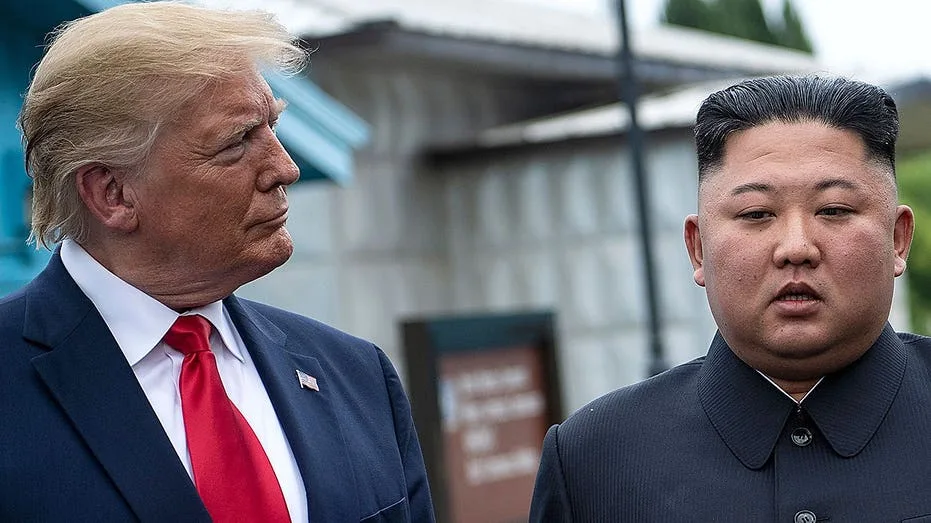
Former President Donald Trump is signaling an interest in resuming high-level diplomatic talks with North Korean leader Kim Jong Un. This renewed outreach comes at a time when North Korea has expanded its nuclear capabilities, forged a robust alliance with Russia, and appears to have fewer pressing reasons to commit to a broad denuclearization deal compared to eight years ago.
Trump's potential return to North Korea diplomacy coincides with ongoing nuclear tensions involving Iran, another unresolved issue from his previous administration. However, the situation with Pyongyang is distinct: North Korea already possesses a mature nuclear weapons program and various delivery systems. This reality severely limits military options and narrows the viable paths for a diplomatic resolution compared to the circumstances during his first term.
Victor Cha, who holds the Korea Chair at the Center for Strategic and International Studies, suggests that Trump may view renewed engagement with North Korea as a strategic maneuver. It could serve to redirect attention from the Iranian nuclear standoff and simultaneously reduce the number of global adversaries the United States currently faces.
Given these evolving dynamics, a comprehensive denuclearization agreement appears increasingly improbable. Instead, any future negotiations might focus on more limited objectives, such as imposing restrictions on nuclear and long-range missile tests, establishing secure crisis communication channels, aiming to weaken Pyongyang's burgeoning ties with Moscow, or pursuing a peace agreement that would allow Kim's nuclear arsenal to remain intact.
Trump's Approach and Potential Goals
This week, Trump stated his expectation of meeting Kim before the year concludes. He has consistently highlighted his personal rapport with the North Korean leader as a valuable asset for restarting diplomatic efforts.
"I get along with him," Trump remarked. "And you know what? The fact that I get along with him, that's a good thing, not a bad thing."
The most achievable outcome for Trump might be a limited agreement focused on mitigating immediate nuclear risks rather than eliminating North Korea's entire arsenal. Cha outlined several potential objectives that fall short of full denuclearization. These include formally prohibiting nuclear and intercontinental ballistic missile tests, reducing North Korea's military and economic connections with Russia, and establishing a direct crisis-management channel between Washington and Pyongyang.
Cha also noted that Trump would likely be interested in a peace declaration or treaty. Such an accord could allow him to claim progress in resolving a conflict that has remained technically unresolved since the 1953 armistice.
Washington's potential negotiating incentives include phased relief from sanctions, adjustments to joint military exercises with South Korea or the U.S. force posture in the region, a possible peace agreement, and the significant political value of direct engagement with a U.S. president. For Kim, an agreement that formally acknowledges his nuclear weapons program could be seen as a substantial step toward North Korea's long-held ambition of achieving de facto recognition as a nuclear-armed state.
Kim may also have an additional motivation for maintaining engagement with Trump. Cha suggested that given Trump's demonstrated willingness to use military force during his previous term, North Korea might view continued contact as a way to reduce the potential for military confrontation.
Shifting Dynamics and Negotiating Leverage
Trump may have already initiated his negotiating strategy. Cha pointed to the recent reduction in joint military exercises between the U.S. and South Korea, a step Trump also took during his initial diplomatic overtures to Kim.
North Korea, however, quickly dismissed this reduction as insufficient, responding the following day by launching approximately 10 short-range ballistic missiles into its eastern waters.
Anthony Ruggiero, who served as the National Security Council director for North Korea during Trump’s first term, confirmed that the reduced exercises align with a pattern established during the former president's earlier diplomatic efforts with Kim.
During their 2018 summit in Singapore, Kim signed a broad declaration committing to work toward the complete denuclearization of the Korean Peninsula. However, that agreement lacked specific timelines or verification mechanisms, and Pyongyang now explicitly rejects denuclearization as a precondition for negotiations.
Eight years ago, Kim faced considerably greater pressure from United Nations Security Council sanctions and a deteriorating food crisis, as Cha recalled. "And in many ways, Trump had the leverage. It's a very different situation now," Cha stated.
This shift in leverage is partly attributable to North Korea's strengthening relationship with Russia. Pyongyang's provision of weapons and troop support for Moscow's conflict in Ukraine has deepened its ties with a powerful partner. Russia can offer economic and military assistance while simultaneously shielding North Korea from further accountability at the U.N. Security Council. China also remains a vital economic partner for Pyongyang.
Despite these new alliances, sanctions relief could still serve as a potent incentive. Ruggiero emphasized that the effectiveness of sanctions diminishes if the United States fails to consistently close the various loopholes North Korea exploits to evade them.
"The North Koreans always complain that the sanctions don't hurt them, but then that's the first thing they always ask for," he observed.
Another tangible humanitarian outcome for Trump could involve the recovery of American war dead. The Singapore agreement included a commitment to retrieve the remains of U.S. service members killed in North Korea during the Korean War. In 2018, Pyongyang returned 55 boxes believed to contain American remains. A future agreement could aim to restart recovery operations within North Korea, where joint U.S.-North Korean efforts last took place in 2005.
However, a sweeping disarmament deal remains improbable. Davenport (an expert mentioned in the original reporting) suggested that Trump should instead concentrate on measures designed to reduce nuclear risk and slow the program's expansion. These could include a moratorium on missile testing, improved crisis communication, and a potential freeze on nuclear development.
"The ideal would be a return of International Atomic Energy Agency inspectors, but that's not going to happen early in the process," Davenport explained.
She added that satellite imagery could still be instrumental in monitoring reactor operations, plutonium reprocessing, and missile testing, although verifying a halt in uranium enrichment would present a much greater challenge.
Crisis Communication and Allied Concerns
The establishment of a direct crisis-management channel holds significant value, particularly because Washington currently lacks a direct military communication line with Pyongyang.
"If all of a sudden our radars pick up a ballistic missile flying through the air, we have no way of contacting North Korea to ask them, ‘Is this your intent? Did you send this?’" Cha highlighted.
Cha also noted a degree of restraint in North Korea's recent actions. While Pyongyang conducted several intercontinental ballistic missile (ICBM) tests during the Biden administration, including launches in 2022, 2023, and 2024, it has not tested an ICBM in flight since Trump re-entered office. Furthermore, North Korea has not conducted a nuclear test since 2017.
Any potential agreement would also inevitably test the strength of the U.S.-South Korea alliance. Seoul might welcome renewed dialogue after years without negotiations, Cha suggested, but it would remain cautious about concessions related to U.S. troop levels or joint military exercises.
Cha indicated that South Korea likely did not receive advance notice of Trump's decision to reduce military exercises. Nevertheless, Seoul could still perceive renewed U.S.-North Korea negotiations as a net positive if they succeed in restarting diplomacy. In the longer term, however, South Korea would seek an active role in any negotiations and assurances that its alliance interests are not compromised in a deal with Pyongyang.
"Where the rubber really hits the road on this is the whole question of U.S. troops in Korea because North Korea would like them out, South Korea would like them to stay, and it's not entirely clear what President Trump wants," Cha concluded.